

If you’ve started looking at AI consulting services in Australia, you’ve probably already noticed how difficult it is to get a straight answer on pricing. One firm quotes $5,000 for a discovery session. Another wants $500,000 for an enterprise transformation. A freelancer on a platform promises full AI implementation for $3,000.
None of those quotes is necessarily wrong — they’re just answering completely different questions.
The reality is that AI consulting in Australia spans an enormous range of scope, maturity, and delivery quality. A strategy workshop with an experienced practitioner who has shipped real AI implementations is a fundamentally different product to a slide deck produced by a generalist consultant who has read the Gartner reports. And a contact centre AI deployment that genuinely reduces handle time and improves customer satisfaction is a world away from a proof of concept that never makes it past the demo stage.
This guide is designed to give Australian business leaders, operations managers, and CX and IT decision-makers a realistic, commercially grounded picture of AI consulting costs in 2026 — what you get at different price points, what drives costs up or down, and how to evaluate whether a given engagement is likely to deliver real business value.
Why AI Consulting Costs Vary So Much
The single biggest reason AI consulting costs vary is that the term “AI consulting” covers an enormous range of activities. Naming a few examples from projects we see regularly:
- A board-level AI strategy briefing for a 500+ person manufacturer
- A generative AI pilot for a customer service team trialling automated email responses
- A full contact centre AI transformation across 300 agents with deep system integrations
- An operational intelligence solution that monitors production data and flags anomalies in real time
- Ongoing AI advisory for a business that already has data science capability but needs strategic direction
Each of these has a completely different cost structure — in people, time, tooling, and complexity.
Beyond scope, costs also vary based on the consultant’s experience, whether they’re implementing or only advising, the integration complexity of your existing systems, your organisation’s data maturity, and frankly, whether you’re working with a specialist AI consultancy or a large generalist firm that has added an “AI practice” to its portfolio.
The other major driver of overspending: businesses often start AI projects without a clear business problem to solve. When the brief is “we need to be doing something with AI,” the scope expands, decisions get revisited, and the bill grows accordingly.
Australian AI Consulting Pricing: What to Expect in 2026
The following ranges reflect what experienced AI consultancies — not offshore generalists or one-person freelancers — charge for work delivered in Australia and New Zealand in 2026.
| Service | Typical Price Range |
| AI Strategy Workshop (half-day or full-day) | $5,000 – $15,000 |
| AI Readiness Assessment | $8,000 – $25,000 |
| Generative AI Pilot / Proof of Concept | $20,000 – $75,000 |
| Contact Centre AI Implementation | $60,000 – $250,000+ |
| AI Automation Project (single workflow or process) depending on complexity and size | $25,000 – $100,000 |
| Enterprise AI Transformation (multi-phase) | $150,000 – $800,000+ |
| Ongoing AI Advisory Retainer (monthly) | $5,000 – $20,000/month |
These are broad ranges, and individual engagements will sit at different points depending on the factors covered in the next section. The most important thing to understand is that the low end of each range typically delivers less commercial value than the high end — not because of margin, but because complexity, integration depth, and change management take time.
What Affects the Cost of AI Consulting?
Scope and clarity of the business problem. Consultants can scope and price precisely when they understand the actual problem. Vague briefs — “improve our customer experience with AI” — generate bloated proposals because every assumption carries risk.
Data readiness. If your data is clean, well-structured, and accessible, AI projects move faster and cost less. If data needs to be cleansed, unified, or governed before AI can be applied, that work adds cost. Many organisations underestimate this.
System integration complexity. Connecting an AI solution to a legacy CRM, on-premises contact centre platform, or a fragmented tech stack costs more than deploying into a modern cloud-native environment.
Whether you need strategy, implementation, or both. Pure strategy engagements (briefings, roadmaps, assessments) are less expensive than engagements that include building, integrating, and deploying working solutions. The most valuable AI consultancies do both. See www.Quanton.ai
Ongoing support and iteration. AI models need monitoring. Prompts get tuned. Thresholds change as your data evolves. Businesses that budget only for initial deployment often find themselves returning for expensive remediation work later.
Change management and enablement. AI implementation that doesn’t include change management often fails quietly. Teams revert to old behaviours, the tool gets abandoned, and the ROI disappears. Good consultancies build this in; it adds cost but dramatically improves outcomes.
Hourly vs. Project-Based AI Consulting: Which Model Works Better?
Most reputable AI consultancies in Australia operate on a project-based or milestone-based model for implementation work, and a retainer model for ongoing advisory. Hourly billing is more common with individual contractors or for smaller, well-scoped engagements.
Project-based pricing works well when the scope is clear, and the deliverable is well-defined — an AI readiness assessment, a specific workflow automation, a contact centre AI deployment with defined KPIs. You know what you’re getting and what you’re paying.
Retainer models suit businesses that are actively building AI capability and need experienced strategic guidance on an ongoing basis — helping a leadership team prioritise AI investments, reviewing vendor proposals, or steering an internal AI team’s direction.
Hourly billing can work for short advisory engagements, but creates incentive misalignment on longer projects. When you’re paying by the hour, there’s no shared stake in delivering outcomes efficiently.
A good rule of thumb: if an AI consultancy can’t give you a project-based quote after a proper discovery session, that’s a signal worth noting.
What’s Actually Included in AI Consulting Services?
This is where many businesses get surprised. “AI consulting” from one firm might mean a 40-page strategy report. From another, it means designing, building, integrating, and deploying a working solution — and then staying accountable for the results.
A thorough AI consulting engagement from a specialist firm typically includes some combination of:
- Discovery and problem framing — understanding the actual business problem, existing processes, data & systems landscape, and commercial objectives
- AI strategy and roadmap — identifying the highest-value AI applications, sequencing initiatives, and defining success metrics
- Technical architecture design — planning how AI solutions will be built, what tools will be used, and how they will integrate with existing systems
- Solution development and implementation — actually building the AI application, whether that’s a generative AI agent, an automation workflow, a predictive model, or a contact centre AI layer
- Integration — connecting the solution to your CRM, contact centre platform, ERP, data warehouse, or other systems
- Testing, validation, and performance tuning — ensuring the solution performs reliably before it goes live
- Change management and training — preparing the people who will use and manage the solution from the outset
- Post-deployment support and optimisation — monitoring performance, iterating on the model, and driving continuous improvement
Not all engagements include everything on this list. But when evaluating proposals, it’s worth being explicit about which elements are included and which are out of scope.
How Much Does a Generative AI Implementation Cost?
Generative AI implementation has rapidly moved from experimental to operational across Australian businesses — particularly in customer service, knowledge management, document processing, and operations.
In practical terms, a generative AI implementation might mean deploying a conversational AI agent that handles customer enquiries, building an internal knowledge assistant that lets staff query business documents naturally, automating email triage and response drafting, or creating AI-assisted quality assurance workflows.
Realistic cost ranges for generative a AI implementation in Australia:
- Narrow, focused pilot (single use case, defined scope, existing platform): $20,000 – $50,000
- Production-grade deployment (one or two use cases, integration, testing, change management): $50,000 – $150,000
- Multi-use-case generative AI program: $150,000 – $400,000+
Costs are heavily influenced by whether you’re building on an existing platform (such as Microsoft Copilot, Salesforce Einstein, or Genesys AI) or taking a custom-build approach, and by the quality of the data and documents the AI needs to work with.
One important note: the cost of the AI model itself — the API usage fees for GPT-4o, Claude, Gemini, or similar — is typically modest compared to the implementation and integration cost. Don’t let low API costs lead you to underestimate what a well-built deployment actually requires.
AI Pilots and Proofs of Concept: What’s a Realistic Budget?
Pilots and proofs of concept have become a standard starting point for AI projects, and for good reason — they let organisations test assumptions before committing to full deployment. But there’s a wide range in what a “pilot” actually delivers.
A well-designed AI pilot should:
- Test a real business scenario, not a sanitised demo
- Use real data (or a realistic proxy)
- Be evaluated against measurable business metrics
- Produce clear learnings that inform a go/no-go decision on full deployment
Budget ranges for AI pilots in Australia:
- Lightweight PoC (narrow scope, limited integration, mainly demonstrates feasibility): $15,000 – $35,000
- Structured pilot (real business scenario, some integration, measured against business KPIs): $35,000 – $75,000
- Scaled pilot (multi-team, production-like environment, readiness to transition directly to deployment): $75,000 – $150,000
Be cautious of very cheap PoCs. A $5,000 “pilot” that runs in an isolated sandbox with sample data tells you almost nothing about whether a solution will work in your environment. It may feel low-risk, but it can generate false confidence that leads to much more expensive failures later.
Is AI Consulting Worth It for Mid-Sized Australian Businesses?
The honest answer is: it depends on what you’re trying to achieve and how you approach it.
AI consulting is genuinely high-value for mid-sized businesses when:
- You have a specific operational problem where AI can create measurable improvement (handle time, processing speed, error rates, customer satisfaction)
- You lack internal AI expertise but have the operational knowledge to direct the work
- You want to move faster than building an internal capability would allow
- You’re at a strategic inflection point and need a credible framework for prioritising AI investment
It’s less likely to deliver value when:
- The primary driver is “keeping up with competitors” without a specific problem to solve
- The organisation isn’t ready to change processes to accommodate AI outputs
- Leadership commitment to implementation is partial or conditional
- The engagement is scoped as “strategy only” without a clear path to execution
For a mid-sized business spending $40,000–$80,000 on a focused AI implementation, a 10–15% improvement in the efficiency of a core process — say, contact centre handle time, invoice processing, or customer onboarding — typically delivers ROI within 12 months. The projects that don’t deliver are rarely the result of the technology failing; they’re the result of poor problem definition, inadequate change management, or implementation that stops at the pilot stage.
How Long Does an AI Implementation Actually Take?
Realistic timelines vary significantly by complexity:
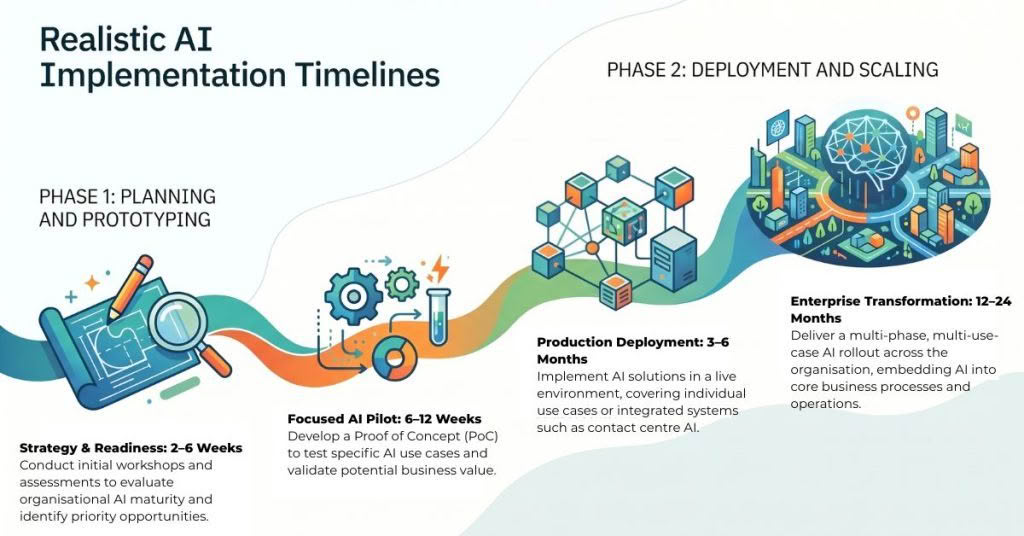
One of the most common miscalibrations we see is the belief that AI projects take longer because the technology is immature. In most cases, the bottleneck is on the business side — data access, stakeholder alignment, IT change management, procurement processes, and the time it takes to get the right people in the room to make decisions.
Good AI consultancies will help you accelerate that process. But no consultant can make your internal governance processes faster if they’re not supported from the top.
What Businesses Often Get Wrong About AI Consulting
This is worth its own section because these mistakes are expensive and surprisingly consistent across industries.
Treating AI as a technology project, not a business change initiative. AI that isn’t connected to a business outcome is a science experiment. The question isn’t “can we build this?” — it’s “what will change operationally when this is deployed, and do we have the leadership commitment to make that change happen?”
Underinvesting in discovery. Businesses that skip proper problem framing and rush to implementation build the wrong thing. Spending $10,000–$20,000 on a thorough discovery and scoping engagement can save $100,000 in rework later.
Evaluating AI consultants on price alone. The firm that quotes $30,000 less may be cutting corners on integration, testing, change management, or post-deployment support — the components that actually determine whether the AI delivers value in production.
Expecting a finished product from a pilot. A pilot is a learning exercise. Treating pilot outputs as production-ready leads to brittle solutions that fail when exposed to real operational conditions.
Neglecting data readiness. If your customer data is fragmented across six systems and hasn’t been governed consistently, no amount of AI sophistication will compensate. Data readiness work isn’t glamorous, but it’s often the highest-leverage investment before an AI project.
Buying tools before defining problems. Many organisations purchase enterprise AI platforms — Microsoft Copilot licences, Salesforce AI add-ons, contact centre AI modules — before understanding what problem they’re trying to solve with them. The result is underutilised licences and frustrated teams.
Disconnected AI experiments. Separate teams running separate AI pilots with separate vendors, each solving their own local problem, produce a fragmented AI landscape that’s expensive to maintain and impossible to scale. A coherent AI strategy prevents this.
Build Internally or Hire an AI Consultant? An Honest Assessment
This question comes up in almost every AI conversation with mid-to-large organisations, and the answer is rarely binary.
The case for building internal capability is compelling if you’re planning to run AI initiatives continuously over the long term, have the ability to attract and retain AI talent (genuinely competitive in the current market), and are operating in a domain where proprietary models or data give you a durable competitive advantage.
The case for external AI consulting is strongest when you need to move fast, when your AI initiatives are episodic rather than continuous, when you lack the infrastructure to support an AI team, or when you need senior expertise and pattern recognition that would take years to develop internally.
In practice, the most effective approach for most Australian mid-to-large businesses is a hybrid: work with an experienced AI consultancy to define strategy, build and deploy initial solutions, and establish the foundations for AI capability — while building internal knowledge in parallel so the organisation can iterate and expand independently over time.
The consultancy relationship shouldn’t create dependency; it should build capability.
Which Industries Benefit Most from AI Consulting in Australia?
In practical terms, the industries seeing the strongest ROI from AI consulting in Australia right now are:
Financial services and insurance — document processing, fraud detection, customer service automation, compliance monitoring, and personalisation at scale.
Telecommunications and utilities — contact centre AI, customer churn prediction, field operations optimisation, and proactive maintenance.
Healthcare and aged care — administrative automation, clinical documentation, patient communication, and workforce scheduling.
Retail and e-commerce — demand forecasting, customer service automation, personalisation, and inventory management.
Professional services and legal — document review, knowledge management, research automation, and client communication.
Manufacturing and logistics — predictive maintenance, quality control, supply chain visibility, and operational intelligence.
The common thread is that these industries have high-volume, repeatable operational processes — exactly where AI delivers the fastest and most measurable return.
What ROI Should You Expect from an AI Project?
Honest answer: it depends on the use case, the quality of implementation, and the organisation’s ability to operationalise the change.
That said, here are realistic ROI indicators from well-executed AI projects:
- Contact centre AI (automated handling, agent assist, quality assurance): 15–30% reduction in average handle time; 10–20% reduction in cost-per-interaction; measurable improvement in CSAT when AI handles routine enquiries and frees agents for complex ones.
- AI automation of document processing or back-office workflows: 40–70% reduction in manual processing time; significant reduction in error rates.
- Generative AI for customer communication (email drafting, knowledge retrieval): 20–40% reduction in time spent on written responses; improved consistency and compliance.
- Operational intelligence (anomaly detection, real-time process monitoring): variable, but often delivers significant value in preventing costly errors or outages.
The most reliable predictor of ROI is not the AI technology itself — it’s the quality of problem definition, the depth of integration, and the organisation’s commitment to changing how work is done.
How Quanton Approaches AI Consulting and Implementation
Quanton is an AI consulting and implementation partner working with organisations across Australia and New Zealand. Quanton also celebrates its 10th anniversary this year helping mid and enterprise businesses automate and streamline core processes. Quanton has built its reputation on a specific belief: that AI only creates value when it’s anchored to real operational outcomes, not technology for its own sake.
We bring deep expertise in AI transformation, having guided businesses through the full journey from initial AI strategy to production deployment — with a particular focus on the operational and human dimensions that determine whether AI projects succeed or fail in practice. Our approach is grounded in the commercial realities that Australian business leaders face: the need to demonstrate ROI, manage risk, maintain compliance, and bring teams along through change.
Quanton’s work spans several interconnected areas:
Aligning AI initiatives with operational outcomes. Every engagement starts with a rigorous understanding of the business problem — not the technology opportunity. The question is always: what operational outcomes are we trying to achieve, and how does AI help us get there faster or more reliably?
Combining AI strategy with implementation. Quanton doesn’t hand over a strategy document and walk away. The team works through from problem definition to deployed solution, which means strategic recommendations are grounded in what’s actually buildable, integral, and sustainable.
Contact centre and customer operations AI. Quanton has specific expertise in applying AI within contact centre environments — deploying conversational AI agents, building agent assist tools, implementing AI-driven quality assurance, and creating operational intelligence that gives operations leaders real-time visibility into performance. For businesses running customer operations at scale, this is where AI investment often delivers the fastest measurable return.
Operational intelligence. Beyond individual automation projects, Quanton helps organisations build the capability to monitor, understand, and improve their operations continuously using AI. This includes integrating AI into existing reporting and workflow systems in ways that give operations leaders genuinely useful, actionable signals.
Avoiding disconnected AI experiments. One of the most common problems in mid-to-large organisations is the proliferation of isolated AI pilots — separate teams, separate vendors, separate tools, with no coherent strategy connecting them. Quanton works with leadership teams to build an AI investment framework that aligns initiatives, prevents duplication, and creates the conditions for AI capability to compound over time.
Responsible AI adoption. AI that isn’t governed well creates risk — regulatory, reputational, and operational. Quanton builds responsible AI practices into every engagement: transparency about model behaviour, bias monitoring, appropriate human oversight, and governance frameworks that meet Australian regulatory expectations.
Can a small or mid-sized business afford AI consulting?
Yes — particularly for focused, well-scoped engagements. An AI readiness assessment or targeted pilot doesn’t require an enterprise budget. The key is starting with a specific, high-value problem rather than a broad transformation ambition.
What’s the cheapest way to get started with AI?
An AI strategy workshop or readiness assessment is typically the most cost-effective entry point. It gives you a clear picture of where AI can create value in your business, what your data and system landscape looks like, and where to focus initial investment — before you spend significant money on implementation.
How do I evaluate different AI consulting proposals?
Look beyond price. Evaluate the consultancy’s track record with similar organisations and problems, the specificity of their approach to your problem, whether they offer implementation accountability or just strategy, and whether they have genuine technical depth or are acting as intermediaries between you and offshore delivery teams.
Do AI consulting costs include software licences?
Generally no — software, platform, and API costs are separate from consulting fees unless explicitly included. Make sure you understand the total cost of ownership for any solution, including ongoing platform costs after implementation is complete.