

In my work with leaders and teams across Australia and New Zealand, I’ve seen how discussions about AI often surface unspoken fears about relevance and job security. I wrote this blog to acknowledge those feelings and to offer a more human perspective—one where AI becomes a tool for growth, not replacement.
Introduction
In my role at Quanton, I spend a lot of time in boardrooms and workshop spaces across Australia and New Zealand, discussing the “future of work.” But recently, I’ve noticed that when we talk about AI, the air in the room often changes. Behind the strategic questions about ROI and implementation, there is a quiet, pulsing anxiety. It’s the elephant in the room: “Will I still have a place here in two years? Will my team?”
If you’ve felt that prickle of unease, I want you to know it’s okay. It’s human. We are living through a period of change that feels breakneck, and it’s natural to view a “black box” technology as a threat to our utility. I’ve spent my career between strategy and engagement, and I’ve come to a conclusion that I hold very dearly: AI isn’t coming for our jobs; it’s coming for the parts of our jobs that make us feel like machines. Don’t be fooled many jobs will be replaced by AI, but to ensure you’re ahead of the curve, embrace, learn and enable yourself with AI to improve your skills and employability.
From Replacement to Reveal
For too long, we have measured human value by output—by how many emails we process, how many rows of data we reconcile, or how many reports we churn out. When we define ourselves by these repetitive tasks, of course AI feels like a replacement.
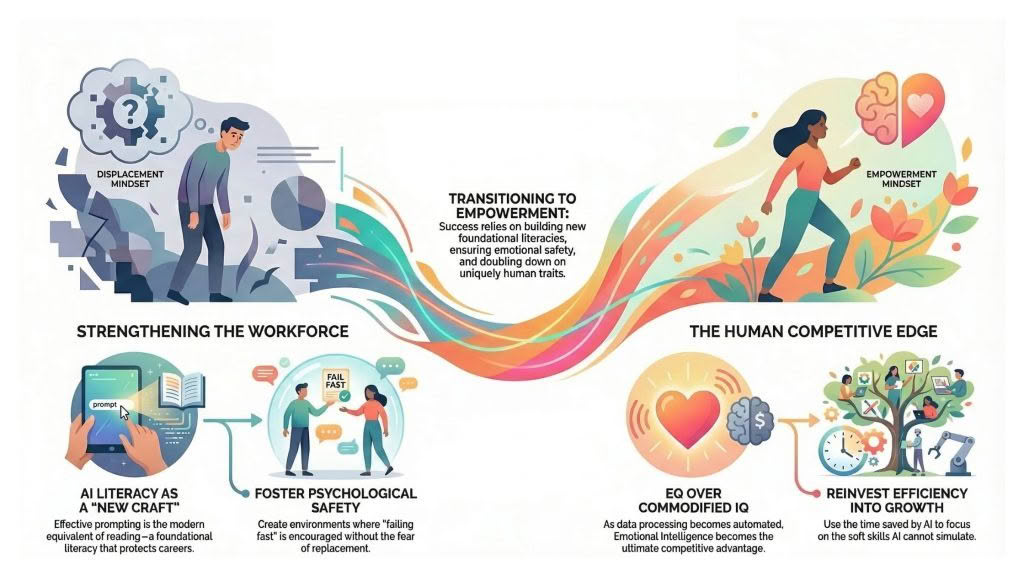
But at Quanton, we view AI as a tool for revelation. By automating the mundane, we reveal the human being underneath the “to-do” list. When we strip away the five hours a week spent on manual data entry, we aren’t losing five hours of value; we are gaining five hours of creativity, empathy, and strategic thinking.
Productivity is not a dirty word, It isn’t about squeezing more out of people until they break. True productivity—the kind enabled by AI—is a form of future-proofing. It’s about increasing a person’s “value per hour” by allowing them to focus on higher-order contributions that a large language model simply cannot replicate: nuanced negotiation, ethical judgment, and complex relationship building.
The Leader’s Mandate: Human Enablement
If you are a leader, your primary job right now isn’t “technology deployment.” It’s human enablement. The difference is subtle but profound. Technology deployment is about software licenses and cloud integration. Human enablement is about psychological safety. It’s about looking your team in the eye and saying, “I am investing in this technology so that you can become more valuable, not so I can find a reason to let you go.”
Protecting the Next Generation
I often think about the graduates entering the Auckland workforce today. They are stepping into a landscape that looks nothing like the one I entered. There is a valid concern that “entry-level” roles—the traditional training grounds where young professionals “pay their dues” through basic tasks—are disappearing.
But I choose to see this as an opportunity to accelerate their brilliance. Instead of spending their first two years in a basement doing coffee runs and spreadsheet audits, young professionals can now use AI to jumpstart their expertise.
Our responsibility is to mentor them in judgment. We must teach them how to critique AI output, how to apply an ethical lens to automated decisions, and how to maintain their unique voice in a world of generated content. By enabling AI skills early, we aren’t just making them employable; we are making them indispensable.
A Future Built on Partnership
Transformation is never just about the “what”—the algorithms or the bots. It is always about the “who.”
At Quanton, our philosophy is grounded in the belief that AI should elevate people and improve people’s lives. When we partner with an organisation, the goal is never to shrink the headcount; it’s to expand the horizon of what that headcount can achieve, thus increasing revenue. It’s about moving a workforce from a state of “doing” to a state of “leading.”
The “AI Revolution” doesn’t have to be a cold, mechanical shift. It can be a deeply human one. It is a chance for us to reclaim our time, to rediscover our curiosity, and to solve problems that were previously too complex or too time-consuming to touch.
Looking Ahead
As we look toward the horizon, let’s stop asking what AI will do to us and start asking what AI will do for us.
If we approach this transition with empathy, if we prioritise the person over the process, and if we commit to lifelong learning, the future isn’t something to fear. It’s something to build—together. The most powerful thing about AI isn’t the silicon or the code. It’s the human spirit it has the potential to set free.