

About Asthma New Zealand
Asthma New Zealand is a nationwide not-for-profit asthma educator, which has set an ambitious goal of slashing asthma and COPD hospitalisation by 50 percent by 2029. Its nursing team provide in-community education, training and support to enable New Zealanders to self-manage their respiratory conditions.
Background
Asthma New Zealand CEO Katheren Leitner took on the role of CEO four years ago, she came in with the specific purpose of scaling the organisation’s reach and, having been exposed to a lot of technologies and emerging technologies in her previous roles, she saw technology as a key part of that.
“I realised quickly that we have nine nurses and it wouldn’t matter if I employed another 50 – we’d still have a patient ratio of 10,000 to one.
“Humans, as important as they are, aren’t enough, we had to develop a triage system and ensure we could remain in contact with our patients for their life-time.” When Leitner first sat down with Quanton she was buzzing with ideas for advanced technologies – a bot here, some conversational artificial intelligence there, integrating systems…
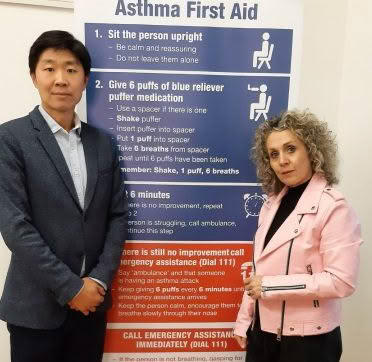
“I could see it all, how it would happen,” she says. Quanton’s response? “That’s fantastic, but where do you currently house your data?”
The answer was in three discrete Access databases built back in the 1980s
Laying the foundations
For all the technologies Asthma NZ wanted to harness, data is key.
Leitner laughs. “I was wanting to go shopping for furniture before the foundations had even been laid.”
It’s an issue Quanton sees frequently, with organisations often embarking on their digital transformation journey without necessarily having the appropriate foundations in place.
Says Garry Green, Managing Director/Founder of Quanton: “Asthma New Zealand wanted to leverage technology to extend their reach, but first we needed to go back to the fundamentals of what they were trying to achieve and how to get there. And in this case, they needed to modernise their operations – around people, processes, technology and, crucially, data.”
That early conversation resulted in a new customer relationship management system – Microsoft Dynamic 365 – for Asthma New Zealand. But it’s also seen the organisation working closely with Quanton’s Operational Excellence Consulting and Business Process Management Services which connects data, people, technology and processes to enable organisations to shape and deliver true end-to-end operational – and digital – transformation.
A ‘plan on a page’
Working with Leitner, Quanton’s Operational Excellence team developed a ‘plan on a page’ – an easy to follow, clear plan looking at where the organisation wanted to be in five years’ time and then breaking it down into one-year blocks of what is needed to achieve those goals.
Notes Ravi Kulatunga, Quanton Operational Excellence Practice Lead: “Before you can travel down a digitisation path, it’s really important to get your business models and your people right.”
One of the key things for digitisation is the availability and access to data to make informed decisions around what technologies you are going to use, he says.
“That is what has come out of working with Asthma New Zealand and the work that has been done.”
Asthma New Zealand worked with Quanton’s Operational Excellence centre on Exponential thinking to approach the problem differently rather than traditional linear approaches. A plan was created that would enable the organisation to make the quantum leap it desired, become an ‘exponential organisation’ and have greatly amplified positive health impact.
“The journey was really about first of all understanding what our technology vision was: What is the purpose of technology for Asthma New Zealand?” Leitner says. “Then to edit, edit, edit it.”
The purpose for Asthma New Zealand was clear: To be able us to reach as many patients as it could with education that inspires self-management – something that has informed all the plans Quanton and Asthma New Zealand are now enacting. A traditional approach would limit the reach of the organisation and not be affordable. However, by adopting new ways of thinking and exponential tools and techniques, as well as the ability to leverage data and technology will extend that reach.

The deployment of Microsoft Dynamics as Asthma New Zealand’s CRM system formed the first step, and is enabling the organisation to improve the productivity of the resources they already have.
The organisation has moved from three discrete Access databases – one in Auckland, one in Wellington and one in Rotorua – which required nurses to take notes manually while visiting patients, then return to the office to input the notes into the system, to a single, cloud-hosted offering.
“Without that all other roads were blocked,” notes Leitner.
Asthma New Zealand has no IT team – everyone employed by the organisation is focused on education in respiratory health –and while it can get funding for capital expenditure such as a CRM system, funding for maintenance and upgrades is much more problematic.
Microsoft’s Dynamics 365, part of the Office 365 suite, cloud hosted and with little requirements for maintenance and no requirement for an IT environment to host it on, proved the CRM of choice after looking at a number of options.
Leitner notes that “We went through a rigorous selection process for the technology. It was critical to have a trusted partner like Quanton to help us as well as manage the implementation and change management. Making a multigenerational leap in technology is not without its challenges, but this was a true partnership that got us the right result, managed our risks as well as being within our allocated budget and hit milestones”.
Nurses are now able to enter data into any smart device, including their mobile, while meeting with patients, eliminating the double-entry previously required with manual note taking and then entering into the system when back at the office.

But the new CRM is only the first step towards a more robust and digitised solution, enabling nurses to use modern technology to know their patient better, communicate with them more efficiently and also enabling management to have better access to data and the ability to create reports for better informed decision making.
“It gives a good foundation to be able to scale up in future,” says John Che, Customer Success Manager at Quanton.
“When that foundation is solid and whatever we need to do either around the Microsoft environment or our side of that, it has a good connector, or integration scalability to open up the database to many applications.
“If we move into AI, machine learning, conversational AI or a patient or doctor portal, they have a very good foundation for all of those future integrations.”
Leitner says within just a few months of starting to use the new system, Asthma New Zealand has seen improvements in completeness and quality of data, and nurse educator productivity.
“We haven’t even gone down the track of making fields mandatory yet, but we will to drive the right habits and behaviour.”
She says the next phase for Asthma New Zealand is all around efficiency and sweating the investments they have made in the system through fine-tuning it and ensuring things are working as well as they can be.
“But in tandem, we’re having the conversation about effectiveness, where we start to overlay the emerging technologies – the conversational AI , machine learning, animation and gamification tools and leveraging exponential thinking to amplify our impact and effectiveness,” Leitner says.
One key barrier for Asthma New Zealand is understanding what patients need assistance – something made more difficult by a lack of referrals from medical staff to the organisation. It’s hoping the CRM will ultimately be able to be integrated into the new national health agency and primary care providers to enable easy referrals. “At the moment I think I’d be very generous if I said we’re getting 20 percent out of what the portal is capable of achieving. There’s a whole lot more things we can do,” Leitner says. “The CRM is driving productivity, but it’s also ensuring we’re getting data so we can further our digital roadmap.”
General Disclaimer
The information in this document is intended for information purposes only.
While we make every effort to ensure that the material in this document is accurate and up to date (as at the date of publication), we do not guarantee, and accept no liability or responsibility of any kind (to the extent permitted by law) arising from or in connection with, the accuracy, reliability, currency or completeness of any material in this document.
The material in this document may be changed, improved, or updated without notice.
This document includes references to registered and unregistered trademarks that are the property of third parties, and that are used with the consent of the trademark owner or as expressly permitted by applicable law.
Date of publication August 2022.
© Quanton Limited 2022
Except as expressly permitted by applicable law, no part of this document may be reproduced (or distributed) in any manner without prior consent.
All rights reserved.