
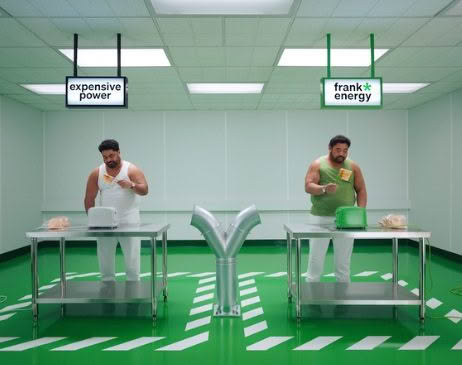
About Frank*Energy
Frank*Energy – previously known as Energy Online – has been focused on making power easy and affordable for Kiwis for more than 20 years. It provides no-contract power and gas. A ‘fiercely’ autonomous offshoot of Genesis Energy, it has a goal of being fully digital, making sign-up and account management intuitive and easy for customers.
Background
Frank*Energy always had ambitious plans for its robotic process automation (RPA) project, and Chris Malcolm, Frank*Energy Senior Product Owner, is open that the projects benefits have been somewhat different from initial expectations.
“The benefits we got were greater than the benefits we sought at the start,” he says. “Initially, we were looking at this to improve customer experience, but we got a lot more than that.”
Malcolm says Frank’s goal is to become fully automated and digital.
“That means the instant you hit the sign-up button you can register, see your account and start doing things,” he says
Until Betty the robot appeared, all sign ups required manual input from Frank*Energy’s customer care agents (CCAs). Whenever a new client signed up and filled out the online forms, a CCA would take that information, paste it into another system and run manual checks on aspects such as location data, along with a credit check.

“We first wanted to work out whether the concept would even work for what we wanted to do, which was a very specific process,” Malcolm notes.
With the PoC proving successful, Frank*Energy went to market for a provider. Quanton, New Zealand’s leading practitioner of automation, and foremost in providing digital transformation services, won the deal.
Betty picks up customer details from the Nexus system and enters it into a Gentrack system, relieving staff of the manual process of copying and pasting data. The robot also initiates ICP checks and credit checks.
“Before the Betty the robot, it took about eight minutes for a customer care agent to complete the signup,” says Malcolm. “Now, for many sign ups, no CCA is involved as the robot does the work. If a CCA has to step in to complete the work, the average time spent has been halved to about four minutes. That’s a massive improvement.”
Our frontline staff find it hard to improve ways of working because of the nature of their job. By having a robot in there doing that stuff, those people are able to move into more value-added work.”
Optimise first, automate next
That has seen Frank*Energy and Quanton turn their focus to other digitisation work, including cleaning up the front end of the web form. When customers sign up and provide their details, Frank*Energy’s web forms enable them to continue even if not all the information is provided correctly.
But Malcolm is frank: The project hasn’t – yet – hit Frank*Energy’s desire for 70-80 percent of all signups to be fully automated. That’s something he says goes back to a key learning for the project:
Make sure you optimise processes before you automate them.
Case in point: addresses.
“If we can’t find your address, we sort it out later. But that meant there were a large number of signups coming through, hitting the robot and then being sent to the CCA to figure out the correct address.”
Working with Quanton, Frank*Energy changed the customer signup journey. Now, if the system can’t find an address, it requests the ICP number and directs customers to where to find that number.
“We have improved the process and made the quality of data hitting the robot that much better more often,”
Malcolm says, adding this is just one example of the tweaks made in the sign-up journey to ensure information is correct and signups can be handled by the robot without handing off to the CCA for exceptions.
“It’s a case of don’t try to automate a process before you’ve optimised it, otherwise you’re automating a flawed process,” Malcolm says.
“The learning was to get your process running really smoothly, optimise it, then automate it. That way you’re going to get a better outcome.”
Taking RPA from tactical, to strategic
Garry Green, Managing Director and Founder at Quanton, says “Automation in isolation isn’t going to deliver the desired benefits for businesses. You need to look at the digitisation and optimisation as well.”
Quanton helped Frank*Energy map the end-to-end process and look at where there was waste to enable optimisation of process as well as digitisation.
“We’ve made further changes to make the robot do more sign-ups end to end, and there are other tweaks Frank*Energy is looking at to make the process even better,” Green says.
There were other challenges too. Malcolm had to navigate through parent business Genesis Energy to enable the enhanced digitisation of Frank.
“Genesis Energy supplies all the infrastructure, so getting virtual machines stood up and deployed and firewall rules created and knowing who to talk to,” says Malcolm. “It’s all the part of the challenge of a project like this.”
Another learning Malcolm notes, is the impact of changes within large organisations and the flow-on effect to the robots.
“You build your robot, and it can point at a particular system. If that system subsequently gets changed, then robot needs to be told the system has changed.
“The problem arises in a big company when systems change in the background, and nobody thinks to tell you. So, change happens in the middle of the night when someone does a release and the robot won’t work anymore.
“Robots aren’t one and done. Your robot is launched and then you need to keep going back and going back to tell the robot about changes.”
Despite that, Malcolm is undeterred and says Frank*Energy is now looking at other processes they can automate.
“We’ve had such success with Betty that we’re inspired to keep exploring how digitisation can help our customers, and spur productivity among our people.”
General Disclaimer
The information in this document is intended for information purposes only.
While we make every effort to ensure that the material in this document is accurate and up to date (as at the date of publication), we do not guarantee, and accept no liability or responsibility of any kind (to the extent permitted by law) arising from or in connection with, the accuracy, reliability, currency or completeness of any material in this document.
The material in this document may be changed, improved, or updated without notice.
This document includes references to registered and unregistered trademarks that are the property of third parties, and that are used with the consent of the trademark owner or as expressly permitted by applicable law.
Date of publication May 2023.
© Quanton Limited 2023
Except as expressly permitted by applicable law, no part of this document may be reproduced (or distributed) in any manner without prior consent.
All rights reserved.