

What was achieved
Mercury has taken its successful business process automation programme, which was already saving the company thousands of hours, from a tactical level to a strategic level.
In 12 months, the first automated process, using RobBee (UiPath Robot) , saved more than 2,000 hours back to Mercury – an average of eight hours a day. This has freed up the team to complete more challenging and engaging tasks.
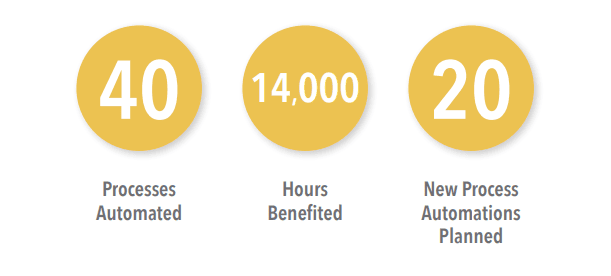
To date more than 40 processes have been automated returning more than 14,000 hours handing time saved annually back to the business.
The Business Process Automation (BPA) team is planning on automating 20 more processes over the next 12-months.
About Mercury
Mercury generates electricity from 100% renewable sources – hydro, geothermal and wind.
Through its 19 power stations, the company generates approximately 17% of the total electricity generated in New Zealand. Mercury also sells electricity and natural gas to customers, with approximately 15% of the total electricity retail market.
Background
It’s one thing to deliver an automation programme. It’s another to lift that automation programme from a tactical level to a strategic level, integrating the outcomes of transformation into the transformative slipstream, alongside capabilities such as continuous improvement.
But that’s what energy generator and retailer Mercury has done in the past three years, delivering transformative outcomes on a strategic level for executives.
The power company selected Quanton as its preferred BPA (Business Process Automation) partner following a procurement process in June 2019.
The initial stages revolved around setting up the BPA practice underpinned by Robotic Process Automation and establishing a CoE (Centre of Excellence).
Quanton’s team was deployed on site, working closely with their colleagues at Mercury. Within a very short time, RobBee came to life, automating the first process for the Switch In Team for the GLOBUG Product (PrePaid Electricity). It’s a process that continues to run, and which in the past 12 months have saved Mercury more than 2000 hours annually, or on average eight hours per day.
Since then, Mercury has deployed four bots across the business, automating more than 40 processes and returning more than 14,000 hours back to the business – freeing up its teams to focus on more challenging and engaging work, leading to increased productivity and better customer experience.
Mercury embarked on this journey as a tactical approach to address some key business challenges, including rising business costs. Identifying how automation could support the reduction in cost and inefficiencies across systems, people and processes was paramount for the business. At the core to Quanton’s approach is their desire to enable businesses to eventually become self-sustainable. It’s an approach that means a high focus by the Quanton team on training and coaching Mercury staff to carry out their own process analysis to identify automation and improvement opportunities.
Cost Savings over Time
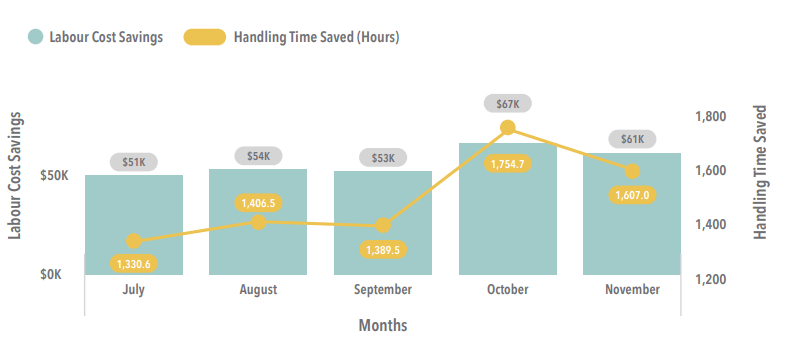
Three years into the programme, the BPA team is well entrenched within Mercury’s operation. The agile approach to delivering automation and the on-going refinement of the Service Delivery Life Cycle (SDLC) has helped to deliver a number of process automations. The BPA team is planning on delivering more than 20 processes in 2022 – that’s nearly one process every sprint!
In July 2021, Mercury decided to ramp up the automation delivery and engaged Quanton’s Advisory and Consulting team to provide guidelines and a roadmap to help support and realise Mercury’s wider transformational objectives.
Right from the outset, the team focused on improving the way people worked at Mercury with the company firmly believing that understanding a problem is the hardest part, and that solving a problem should be more about people than about technology.
Powering up long term success
Working closely with the Mercury Automation team, a Strategy on a Page (SOAP) and a roadmap to traverse the gap between where the team was and where they wanted to get to was developed.
The key here was that the success measures and goals set were wider-ranging and not limited to the tactical, short-term goal of saving costs. Instead they were aligned with the business unit and corporate goals as well.
The voice of customer (VoC) and the voice of the staff (VoS) became key drivers for the Automation Team.
“The challenge was shifting expectations from the immediate, tactical benefits towards a more sustained strategic approach to business transformation,” Mercury says. “Employing an approach that encompassed a wider range of strategic benefits and weighing this up against a cost-only approach was the recipe for success.”
Since beginning its quest to support businesses to deliver benefit through automation, Quanton has continuously looked at its own approach and methodologies to find ways to improve them. This philosophy was also adopted by the Mercury Automation Team and they set about analysing their Service Delivery Life Cycle to uncover ways of improving it and making it even more agile. The SDLC is always evolving and reflects the automation maturity of the organisation. The improvements that have been made to the approach so far means turn-around time for a deployment is reduced.
Working closely with business owners, the Automation Team has been conducting Value Stream Mapping workshops to understand, document and deliver operational benefits across end-to-end processes. This top-down approach means that the end-to-end process is analysed and both automation and non-automation (process optimisation and re-engineering) opportunities are identified and implemented.
This has changed the way the automation pipeline is defined and delivered, and the benefits are more strategic now – an approach that Mercury immediate saw benefit from.
Value Stream Mapping
One of the key reasons Mercury decided to take a different approach and redirect the trajectory of the BPA programme was to enable wider benefit realisation.
While the initial tactical deployment delivered benefit, Mercury wanted to build on this. They set a challenge of continuing to improve the operational efficiency through automation, while maintaining roughly the same costs. It was a goal that required a different approach, and Quanton was called on for guidance.
Value stream mapping (VSM) is a LEAN tool that Quanton employ to harvest greater, and wider, business benefit. It complements business process automation and starts to identify wider improvement opportunities such as process re-engineering and optimisation, as well as automation requirements.
One of the immediate outcomes of this approach was that it started to inform and change the automation priority backlog. Automation deployment started to cluster and align to the business’ value streams, realising economies of scale and scope and refocusing the focus of the Automation Team’s work.
With the help of the process owners and subject matter experts, quick process improvement wins were realised, and the teams started to witness immediate benefit. These benefits included improving the customer experience, reducing costs, and minimising repetitive, nonvalue-added tasks.
It’s a familiar scenario for Quanton.
“Value stream mapping transitions the typical silo-built organisations and encourages teams from different departments to come together to solve organisational problems. This extended out to include suppliers, as an operation’s performance is invariably dictated by its inputs, or the supplier’s processes.
“Involving customers in value stream mapping workshops is also an important part of the process as it redefines the problem from the customer’s perspective. So, you are not just solving the right problems, but you are also developing optimal solutions.”
Agreeing on what the standard process is, or the ‘happy path’ is always a challenge when developing automation solutions, because it is not unusual to find people working within the same process, working differently. Engaging the entire team in the value stream mapping process ensures both a standard and best practice.
A notable and important outcome from the initiative is the engagement of Mercury’s staff. Involving staff in problem solving and developing creative solutions to these problems helped in lifting staff satisfaction levels. Supporting greater operational efficiency through process improvements and automation, meant staff can now work on projects that deliver value to Mercury and its customers. “We want future goals to be orientated around individual capability and future ways of working, as well as linking closely to value delivery. This will help us become nimbler in how we respond to changes in customer needs,” Mercury says.
General Disclaimer
The information in this document is intended for information purposes only.
While we make every effort to ensure that the material in this document is accurate and up to date (as at the date of publication), we do not guarantee, and accept no liability or responsibility of any kind (to the extent permitted by law) arising from or in connection with, the accuracy, reliability, currency or completeness of any material in this document.
The material in this document may be changed, improved, or updated without notices.
This document includes references to registered and unregistered trademarks that are the property of third parties, and that are used with the consent of the trademark owner or as expressly permitted by applicable law.
Date of publication February 2022.
© Quanton Limited 2022
Except as expressly permitted by applicable law, no part of this document may be reproduced (or distributed) in any manner without prior consent.
All rights reserved.