
Since joining Quanton in June 2026, I have had the same conversation with leaders across New Zealand and Australia in a dozen different forms. It almost never turns out to be a technology conversation.
I wrote this to name what I think is really holding organisations back — and what leaders can do about it.
Since joining Quanton in June 2026, I keep coming back to a question that sits behind almost every transformation conversation. It is not a technology question. It is a leadership question.
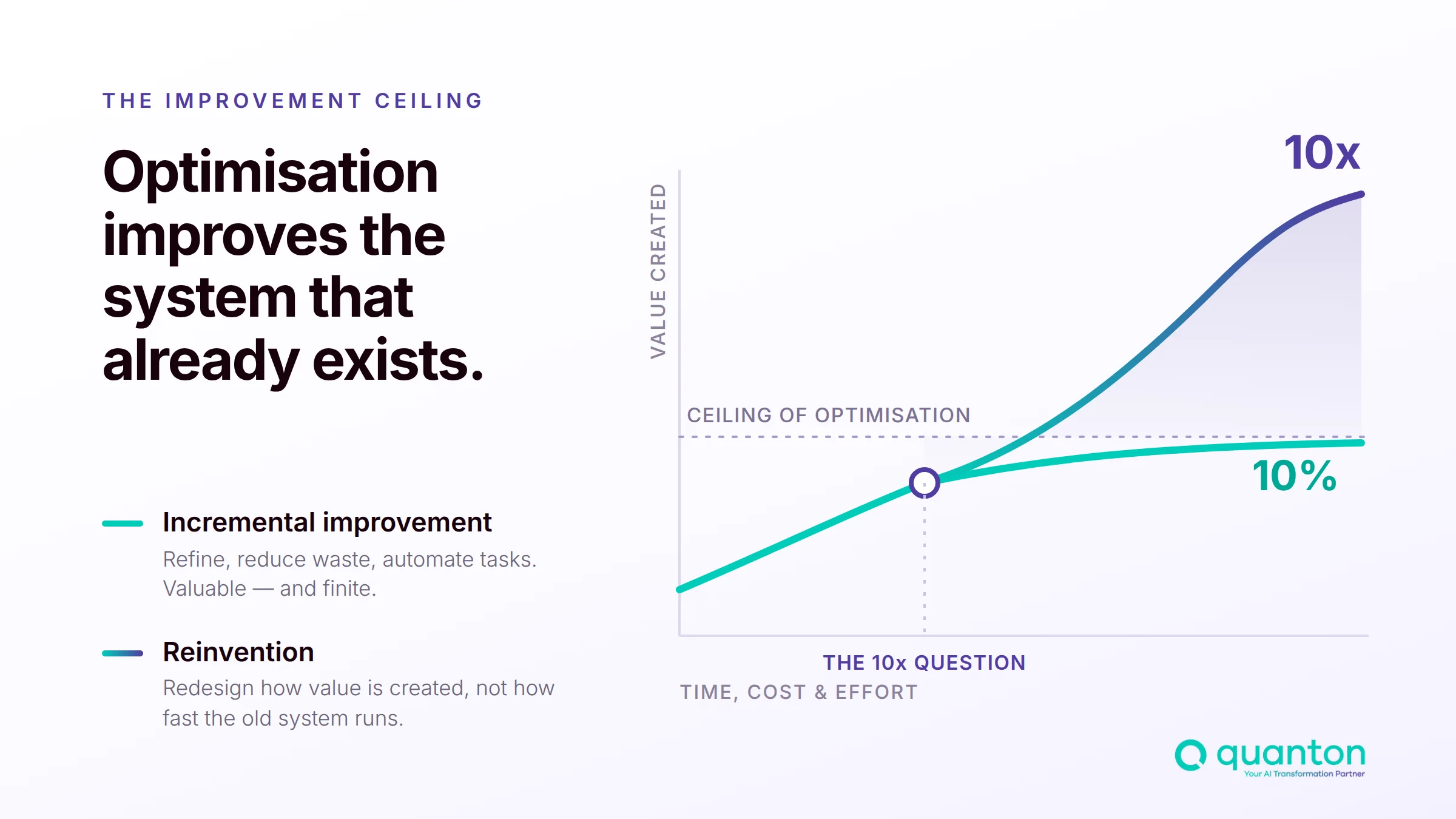
Most organisations already know how to improve by 10%. They refine, reduce waste, improve utilisation, introduce better reporting and automate individual tasks. That work matters, and many organisations have become very good at it.
But incremental improvement has a ceiling. It improves the system that already exists.
If we had to deliver ten times more value without ten times the people, cost or complexity, how would we redesign the way the organisation operates?
Ten times the value does not necessarily mean ten times the revenue. It could mean serving ten times the customers without proportionally increasing cost. It could mean compressing a ten-day process into one. It could mean moving from retrospective reporting to decisions being made in real time.
At some point, the answer is no longer optimisation. It is reinvention.
This is a challenge that extends beyond individual organisations. For decades, NZ Inc has largely grown by adding labour and expanding activity rather than dramatically increasing the value created by each hour worked. Organisations face the same dilemma.
Eventually, growth through more people, more meetings and more effort becomes increasingly difficult. The next leap comes from redesigning value creation.
Why tighter management is not enough
This is not an argument against good management. Strong management creates clarity, accountability, discipline and consistency. Those are essential to any high-performing organisation.
The problem arises when leaders assume transformational results will come from more supervision, tighter controls, additional reporting and greater pressure on the existing system.
Traditional management models were largely designed for consistency: define the task, monitor the output, correct the variance and repeat. That works when the goal is control. It works less well when the goal is reinvention.
Transformational organisations create the conditions for distributed ownership. People solve problems they were not explicitly assigned. Teams challenge assumptions rather than simply following established routines. Opportunities are acted on before they need to become formal initiatives.
Some call this intrapreneurship: people thinking and acting like owners inside someone else’s organisation. Whatever term is used, most organisations already employ people capable of it. The leadership challenge is creating an environment in which that capability can emerge.
Distributed ownership does not mean removing governance or allowing everyone to act independently.
The real goal of modern operating systems is not control. It is clarity.
When people understand what success looks like, can see performance in real time and are trusted to act, ownership scales.
The role of leadership is less about directing every action and more about creating the conditions where good decisions happen consistently. It means making the direction, decision rights, measures and boundaries clear enough that people can act without waiting for permission at every step.
What 10x looks like in practice
Increasingly, the leaders I speak with are not asking how to get more data. Most organisations are no longer data-poor. They are decision-poor.
The challenge is rarely the availability of information. It is creating the visibility, ownership and operating discipline required to consistently turn insight into action, and action into performance outcomes.
Consider a common reporting process. A leadership team might initially ask how automation or AI could reduce the time required to produce a monthly report by 20%.
“How could automation or AI reduce the time it takes to produce the monthly report by 20%?”
That is a useful improvement question. But the 10x question is different.
“Why are we waiting until the end of the month to understand performance at all?”
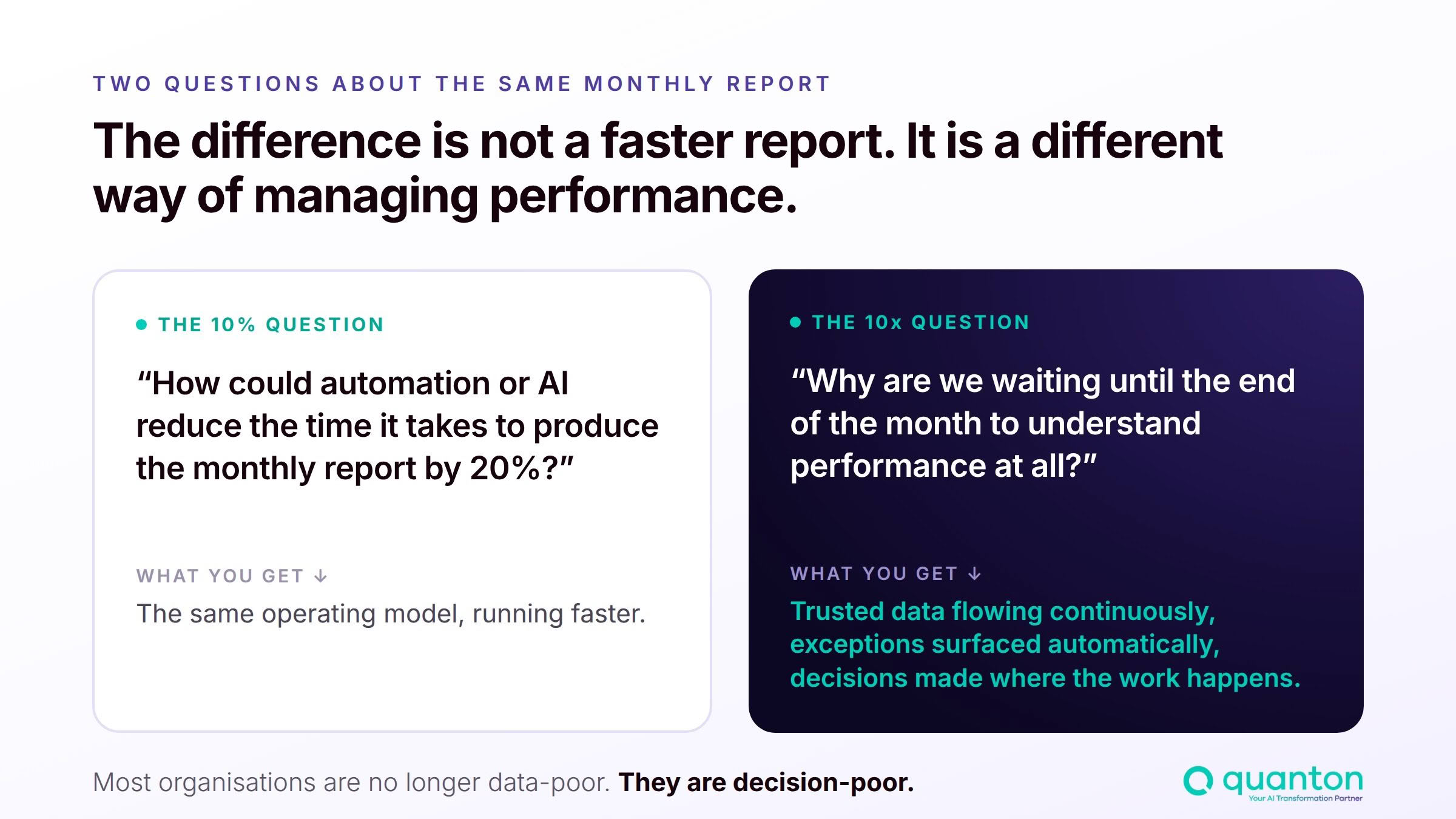
That second question may lead to a completely different operating model: trusted data flowing continuously, exceptions being surfaced automatically and decisions being made closer to where the work happens.
The difference is not simply a faster report. It is a fundamentally different way of managing performance.
This is where systems, data and AI create real value. Not by making every existing activity slightly faster, but by enabling leaders to challenge why the activity exists in its current form.
Discipline enables innovation
Transformation conversations often create a false choice between discipline and innovation. In reality, the two reinforce each other.
The organisations achieving the greatest returns from AI, automation and advanced analytics are rarely the most chaotic. They tend to understand their operations, have defined ways of working, trust their data and can clearly see their performance.
That foundation creates confidence, and confidence makes experimentation affordable. When standard work is documented and performance is measurable, a failed experiment creates a lesson. Without that foundation, it creates disruption.
That is why the sequence matters. I like to describe the journey in three clear phases.
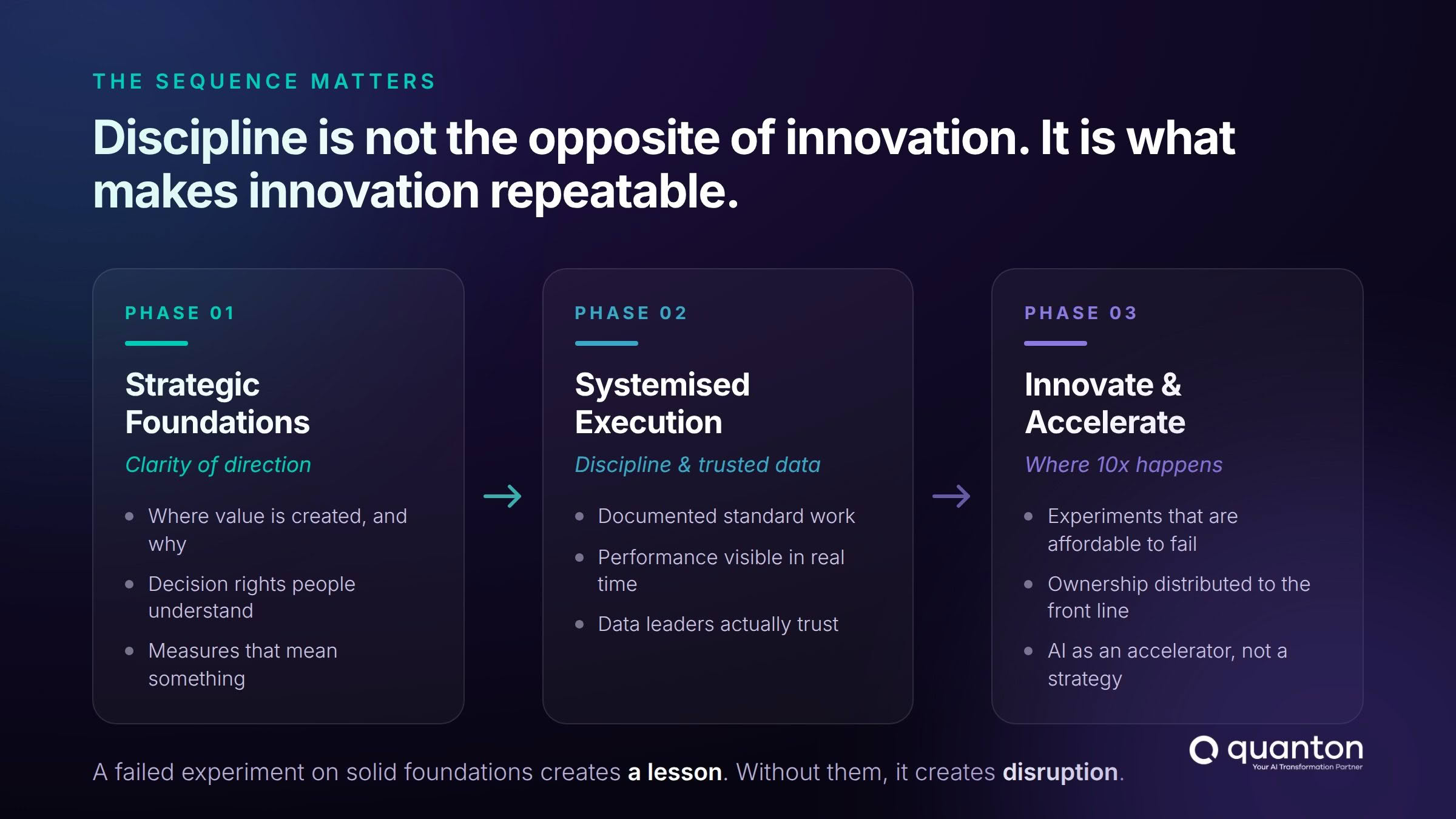
Discipline is not the opposite of innovation. It is what makes innovation repeatable.
What high-performing organisations do differently
The strongest organisations are not necessarily those with the most sophisticated technology. They are the ones where people act with ownership at every level.
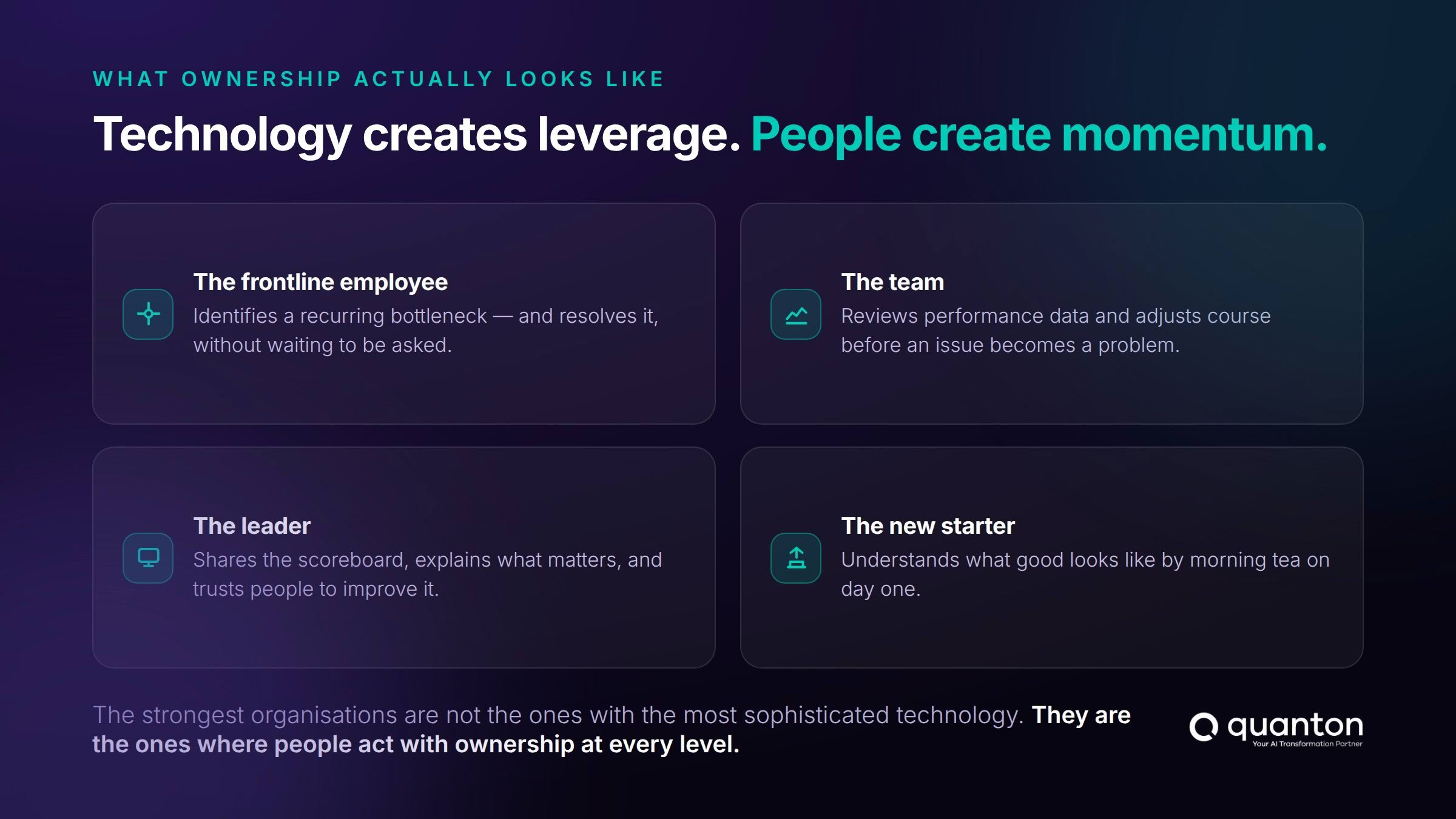
These organisations understand something that is often missed.
Technology creates leverage. People create momentum. Leverage without momentum rarely delivers the outcomes leaders expect.
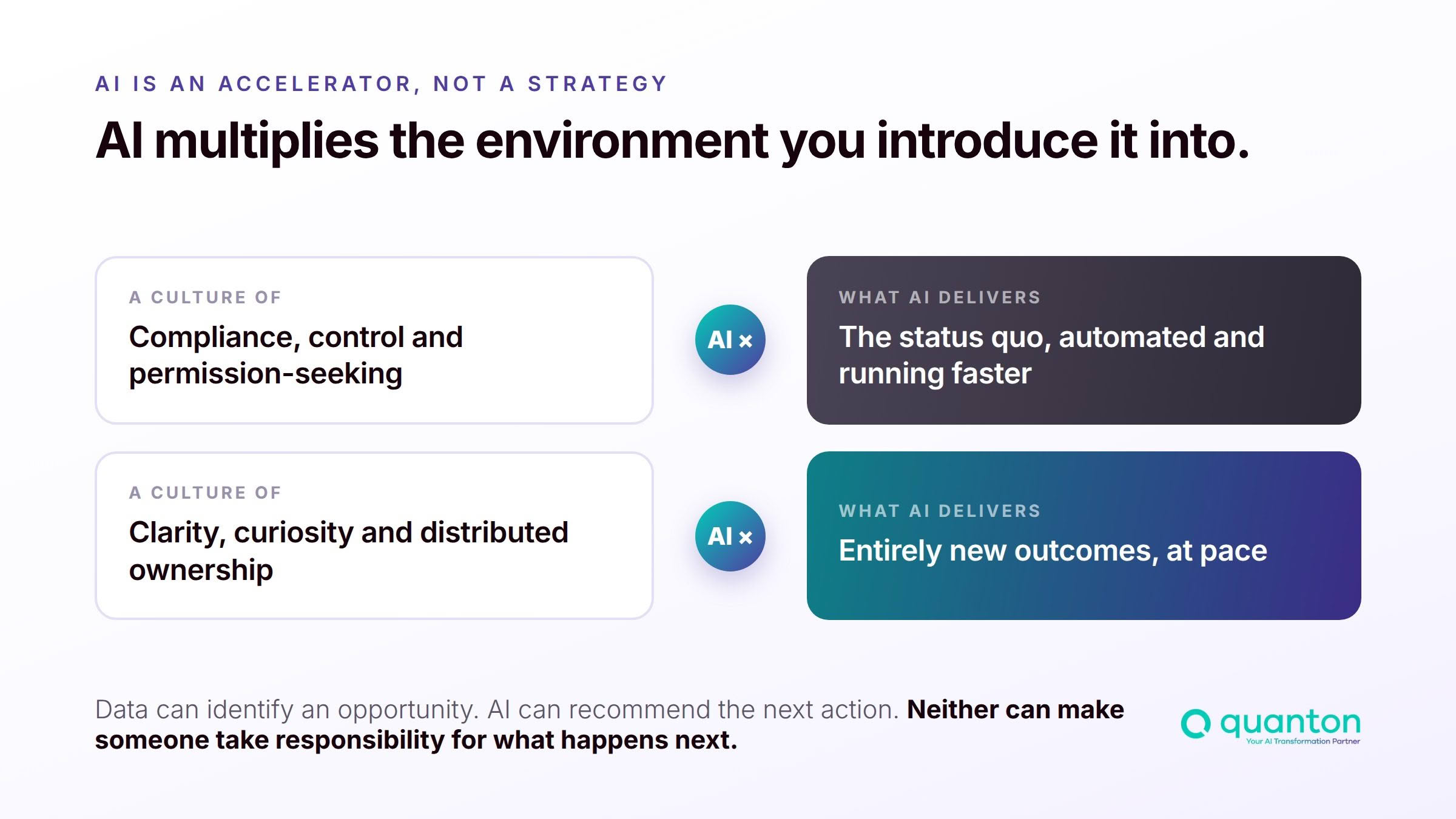
AI will multiply the environment into which it is introduced. Introduce it into a culture centred on compliance and control, and it may simply automate the status quo. Introduce it into a culture of clarity, curiosity and ownership, and it can accelerate entirely new outcomes.
The ambition question
Quanton’s Massive Transformational Purpose is Empowering Humanity for Tomorrow’s Technology, Today. What stands out to me is what comes first: people.
The constraint on transformation is not the platform, the data or the funding. More often than many leaders would like to admit, it is whether the ambition and capability already present within the organisation are being allowed to surface.
AI, data and automation will not determine which organisations win over the next decade. Leadership will.
The organisations that thrive will be those that create clarity, build ownership, trust their people and use technology to amplify what already works.
The rest may improve by 10%. The leaders willing to rethink how value gets created have an opportunity to achieve something far greater. That is as true for New Zealand’s forty-year productivity story as it is for any single business.
Because you can’t manage your way to 10x. But you can build an organisation capable of achieving it.
Where would 10x thinking take your organisation?
Quanton helps organisations across Australia and New Zealand align strategy, execution and AI capability — without the transformation theatre.
If this raised a question you would like to explore, we would welcome the conversation.
Start a conversation