
About Chorus
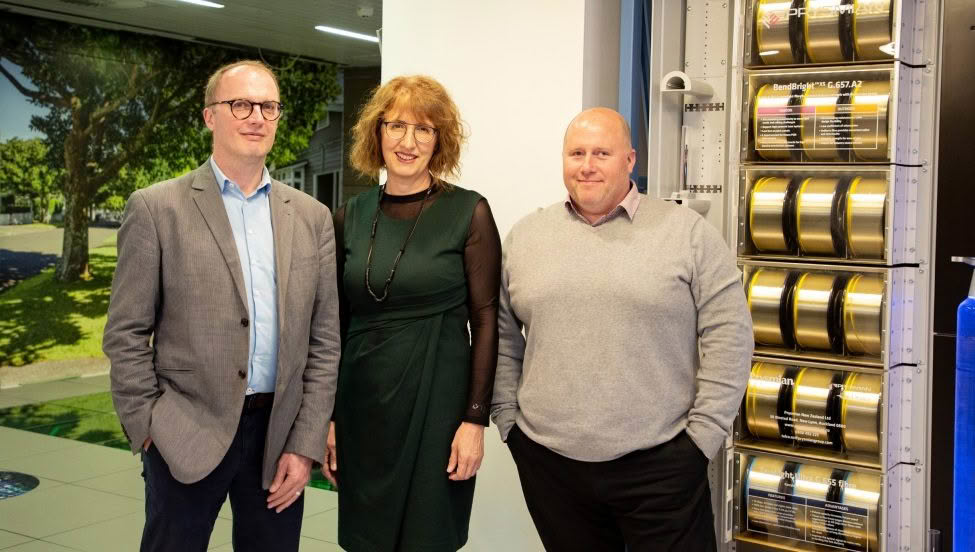
Chorus is New Zealand’s largest telecommunication and infrastructure provider. The company has been central to the country’s open access broadband fibre rollout proving Ultra-Fast Broadband (UFB) to hundreds of thousands of Kiwi homes and businesses.
Chorus is one of Quanton’s earliest customers, being one of the first organisations to initiate a Blue Prism Robotic Process Automation (RPA) programme in New Zealand.
With Quanton’s help, Chorus successfully established an Automation Centre of Excellence, Robotic Operating Model and developed internal capability to manage the total automation lifecycle.
Today Chorus have a digital workforce with twenty software robots which complete over 55,000 transactions a month.
Driving a Digital Change
As New Zealand’s largest provider of telecommunications infrastructure – both the copper networks from its days as part of telecom (now Spark) and the fibre broadband network rolled out under New Zealand’s Ultra-Fast Broadband (UFB) project – Chorus is on a mission to be more digitally enabled, embracing technology to help modernize its business and its customer service.
The company has long relied on automation in its many forms, from large scale automation integration to simple macros.
But there are some areas where large scale automation integrations just don’t stack up and aren’t cost effective, particularly areas which Robyn Malcom, Chorus Manager Optimisation and Insights, dubs ‘edge use cases’.
Enter Robotic Process Automation (RPA).
“We’ve found for edge use cases the business case didn’t stack up, so we’ve used software robotics to fill in some of those cases for large scale automation that had been previously left untouched,” Malcolm says.
Case in point: Fibre provisioning. The company handles over 20,000 new connection requests for fibre a month, along with more than 8,000 update requests.
The Solution: Robotic Process Assistants
Chorus is one of Quanton’s earliest customers, being one of the first to initiate an RPA programme in New Zealand using Blue Prism software Robots.
The company started with three processes and five robots. Today it has six core processes automated and 20 robots running these processes, seamlessly managing peaks in demand.
“We are very volume driven and our volumes aren’t consistent,” says Fraser Hill, Manager of Service Automation for Chorus.
“The robots allow us to more effectively manage these peaks in demand”.
Three of the processes are BAU around connecting customers to the network. They’re processes which have been in play for a long time, and will, Hill says, continue to be key, but they’re also heavily ‘swivel chair’ based on the application of rules and workflow for orders within the company’s core systems.
“They’re specifically focused on filling the gap between new systems and legacy systems,” Malcolm notes. “That’s a key thing.”
The software robots are freeing up capacity to enable Chorus’ staff to do more valuable work, rather finding themselves in the swivel chair, copying and pasting information from one area to another.
The company has previously been responsive through increased use of its human team, but with volumes fluctuating, Hill notes that can create headaches.
“The robots really help us to be reactive and responsive. We can scale them up really quickly to be more customer responsive than we could be before.”
He says there is a real productivity boon with the robots now managing around 55,000 transactions a month – the equivalent of around 12 to 16 FTEs. Their work didn’t slow down through Covid-19 lockdowns either, with the robots unimpacted by the lockdowns and changes to working practices.
The second set of processes involve a five-year service migration project – migrating old end-of-life services on the copper network and legacy systems into new services and platforms.
It’s a programme of work that will ultimately see more than 100,000 customer services migrated onto new technology platforms, with the volume of migrations increasing incrementally over the five-year project timeframe.
“One of the real benefits of using the robots in this scenario is that the activity is generally done out of hours and isn’t normally done over a consistent timeframe,” Hill says. “So we may do one migration one week, three the next, two the next, and RPA gives us the ability to manage that without having to have either a large team of underutilised people, or trying to push work into teams where it’s not a great fit for their role.”
“To manage it with people would be exponentially larger as you would need more people to deliver in short windows, they would work unsociable hours, require leadership and be largely unutilised for the remainder of the working week.
“So, it was a really good opportunity to ask, ‘could we do this differently?’ And then utilise RPA to do that.”
Managing expectations and concerns
Malcolm notes that Chorus made a point to focus on having conversations with its team about RPA early on to manage expectations around the processes.
“We have a lot of automation already and a lot of projects delivering automation, but for some reason, this type of automation – software robotics – often comes with a lot more noise around it.
“For that reason we consciously spent a lot of time at the beginning telling the story and talking about what we were doing to settle any concerns people had.
“Now, however, it’s an operational part of the business and those questions and concerns are few and far between,” Malcolm says.
New Tools for the Toolbox
In fact, Malcolm and Hill are both adamant that automation itself shouldn’t be the topic.
“The conversation is less around what the solution is going to be. People hone in on the fact it’s robots, or AI, or some other technology, and get hung up on that. But in reality, it’s just an enabler, a tool,” Hill says.
“It’s just an extension of what is done in every business today in the technology space, but it is working alongside that to fill the gaps or do smaller bits of automation – at least that’s how it is for Chorus.”
Adds Malcolm: “We see software robots and RPA as one of the many tools we can use within a raft of
“It’s about having the right tool, for the right job.”
Chorus is now looking at what other tools it can bring in to sit alongside RPA and improve automation in the edge space.
“When we started off on this journey, we thought the benefits of robots would be that they would be faster,” says Malcolm. “But, in reality, they’re not necessarily faster, but they give you a whole other level of reliability, flexibility, accuracy, hours of operation and consistency.
“It’s a slightly different range of benefits to where you might start the conversation.
A Changing Partnership
Quanton initially had a team of staff working on site at Chorus and helped train up an internal team for the business.
Garry Green, Quanton Managing Director, says “We designed a programme to support Chorus’ strategy which was to establish a Centre of Excellence as well as automating their initial three processes. Importantly we assisted with the development of their robotic operating model and training their team so that they were self-sufficient. We are now in a support role where we provide continued expertise, advice and thought leadership.”
That’s a model which has been a winner for Chorus.
“Quanton have been our partners all along, but the role it has played has changed as its stepped back and given us the reins. That’s been great from a partnership point of view,” says Malcolm. “And if we get complex issues or we need support, we can quickly pull them in for assistance”
General Disclaimer
The information in this document is intended for information purposes only. While we make every effort to ensure that the material in this document is accurate and up to date (as at the date of publication), we do not guarantee, and accept no liability or responsibility of any kind (to the extent permitted by law) arising from or in connection with, the accuracy, reliability, currency or completeness of any material in this document.
The material in this document may be changed, improved, or updated without notices.
This document includes references to registered and unregistered trademarks that are the property of third parties, and that are used with the consent of the trademark owner or as expressly permitted by applicable law.
Date of publication October 2020.
© Quanton Limited 2020
Except as expressly permitted by applicable law, no part of this document may be reproduced (or distributed) in any manner without prior consent.
All rights reserved.